Weather Scope NOAA Live Radar
- 4.5
- Rating
- 100.00K
- Installs
- Free
- Price
 Analysis by App-foxy
When I need a quick answer to a very practical question—whether I should leave now, delay a walk, protect outdoor equipment, or keep an eye on a developing storm—I want a weather app that helps me move from uncertainty to a decision. Weather Scope NOAA Live Radar is built around that moment. It combines radar, forecasts, hurricane tracking, and customizable snow alerts in a free weather app from Aviator Assistant. After using it as a day-to-day weather companion, I found its strongest quality is not simply showing more information, but putting several useful views close together when conditions are changing.
The app is aimed at people who want more than a temperature and a small weather icon. Its focus on NOAA radar makes it particularly appealing when rain bands, snow, or severe weather matter more than a general outlook. It is available to everyone, works on Android from version 8.0 onward, and has reached over 100 thousand installs. Its average rating is 4.6 from around 4 thousand ratings, which suggests that the overall experience has connected with a substantial group of users, although personal expectations about radar apps can vary considerably.
From a vague weather worry to a usable plan
I find the most useful way to approach this section is to begin with the decision, not the map: what would make me change my plans today? That keeps radar and forecasts focused on a practical question instead of inviting endless checking. From there, I can consider how a shared household might turn one person’s weather check into a clear plan for everyone else.
You May Also Like

 Blood Strike: 2.5 Anniversary
Blood Strike’s Loadouts Turn Every Drop Into a Tactical Gamble
A close look at Blood Strike’s custom loadouts: how fast access to signature weapons reshapes its battle royale rhythm, rewards preparation, and narrows the gap between fights.

 Pandora - Music & Podcasts
Pandora’s Music Is Easy to Start, but Harder to Recover
Pandora’s strength is its low-effort path from a seed to a station. Its weak spot is how much confidence it asks you to place in connection, setup, and quiet recovery.

 8 Ball Pool
 Is Built on Rivalries, Rematches, and Routine
A close look at the rivalries, rematches, shared routines, and unanswered safety questions that turn a quick pool match into a persistent mobile community.

 Samsung Music
’s Quiet Strength Is Playing What You Already Own
Its reach comes less from spectacle than from dependable access to a personal library. That simplicity is both the app’s strongest retention engine and its ceiling.

 AccuWeather: Weather Radar
AccuWeather Review: A Quick, Clear Forecast for Everyday Decisions
For everyday plans, the best forecast is the one you can understand quickly. AccuWeather makes rain timing, radar, and local conditions easy to act on, with a few trade-offs.

 Hill Climb Racing
Why Hill Climb Racing Still Turns Crashes Into One More Run
A tiny car, a bumpy hill and one more upgrade: Hill Climb Racing keeps resurfacing because its simple chaos makes every near-miss feel personal.
More From Our News Desk
View All News


The starting condition: deciding whether the forecast is enough
My usual starting point is not “What is the weather?” but “What should I do because of the weather?” A basic forecast is often enough for choosing a jacket, yet it can be too broad for a commute, a school pickup, a flight-related schedule, or an outdoor job. A forecast may say rain is possible, while radar can show whether a moving line of precipitation is actually approaching my route.
That is where Weather Scope NOAA Live Radar makes sense. I can begin with the wider picture, then use the radar view to understand what is happening around me. This is a better workflow than repeatedly opening a standard forecast app and guessing from a percentage. The radar does not remove uncertainty, but it gives the forecast some visible context.
I also like that the app is not limited to ordinary daily conditions. Hurricane tracking gives the app a more serious use case during tropical weather, while customizable snow alerts are aimed at a narrower but very practical need. Those tools matter most when weather affects preparation rather than just comfort.
Step one: establish the local situation
I start by checking the current forecast for my location, then move to the radar when timing matters. This order is useful because it prevents me from staring at a moving map without knowing what outcome I am trying to judge. If I only need a broad idea of the day, the forecast is the faster stop. If I need to know whether precipitation is likely to reach me soon, radar becomes the more relevant screen.
A practical example is a late afternoon drive. Before leaving work, I can check the expected conditions, then inspect the radar to see whether a nearby band is moving toward the route. If the weather looks settled, I do not need to overanalyze the map. If a large area of rain is approaching, I have a reason to leave earlier, wait, or choose a different plan.
The useful habit is to treat radar as a decision tool, not as entertainment. Weather maps can invite endless zooming and panning, but the best result comes from asking a specific question: is the weather likely to interfere with my next action?
Step two: use the radar for timing and direction
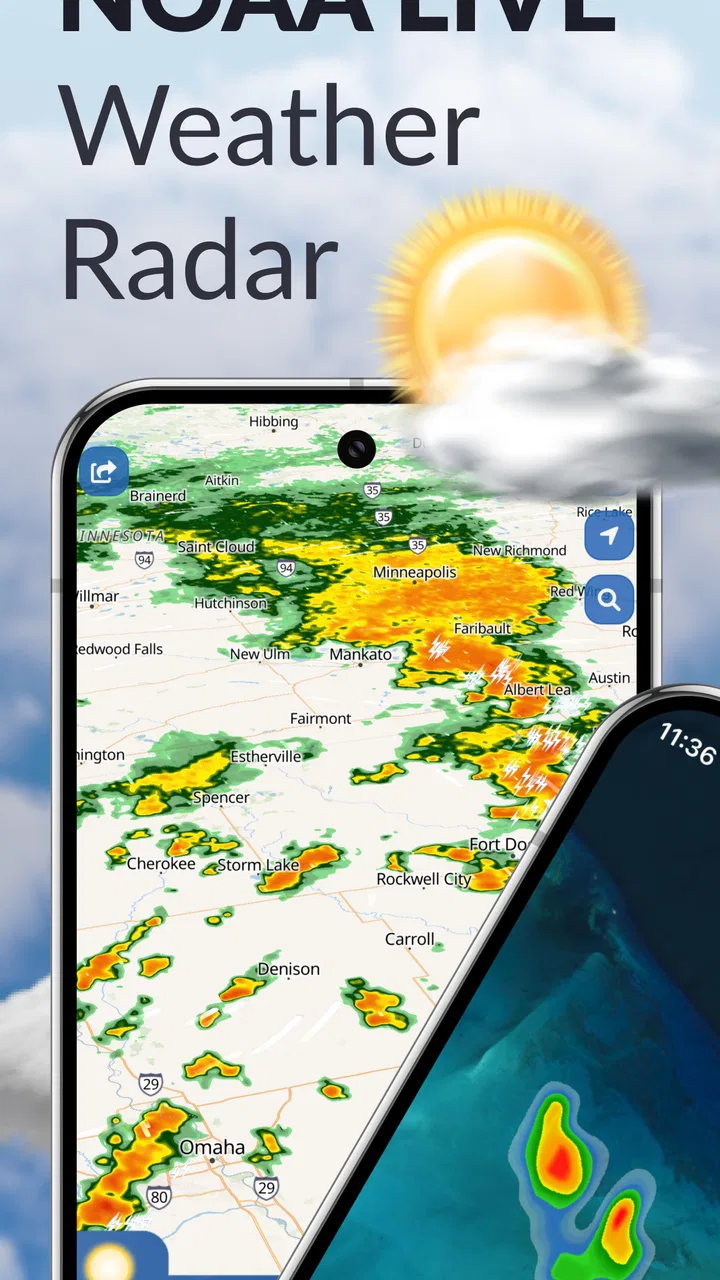
The radar view is most valuable when I need to connect location with movement. Instead of reading a single condition for the whole day, I can look at the shape and position of precipitation near the area that matters to me. That helps me distinguish between rain that is already passing, rain that is building nearby, and a clear gap that may be useful for a short trip.
This does not mean I would use the app as a guarantee for an exact departure minute. Radar interpretation still depends on how quickly conditions change, how far away the weather is, and whether the system is developing faster than expected. My recommendation is to use it for a short planning window and then check again before committing to a longer journey.
One non-obvious advantage is that the radar can change how I read a conventional forecast. A high chance of rain does not necessarily mean continuous rain all day, and a low chance does not mean every outdoor plan is safe. Looking at the nearby pattern gives me a more realistic sense of whether I am dealing with a passing shower or a broader weather system.
Step three: switch from ordinary rain to higher-impact weather
When a tropical system becomes relevant, hurricane tracking gives me a dedicated way to follow it rather than relying only on the regular local forecast. This is important because a hurricane is not just a daily temperature problem. Its location, movement, and broader effects can influence travel, preparation, and decisions over several days.
I would use this part of the app as one layer in a careful information routine. I can begin with the track to understand the general situation, then compare that with local conditions and official guidance before making safety decisions. The app is helpful for keeping the weather picture organized, but a radar screen should not replace emergency instructions or local authorities during a dangerous event.
That distinction is easy to overlook. A weather app can help me notice a system and follow its development, while the final decision to evacuate, shelter, or cancel travel belongs to a broader safety process. Weather Scope is useful in the information-gathering stage, not as a substitute for emergency communication.
Step four: turn snow information into an alert workflow
Snow alerts are especially useful when I do not want to remember to check the app repeatedly. A customizable alert can support a simple workflow: set the kind of snow-related notification that matters to me, then let the app bring the issue back to my attention. That is more practical than opening a weather screen every morning during a period of uncertain winter conditions.
The word “customizable” matters here because not every user needs the same threshold or level of warning. Someone planning a commute may care about an approaching accumulation, while another person may only want to know about a more disruptive event. I would spend a little time adjusting the alert rather than accepting every possible notification. Otherwise, useful warnings can become background noise.
A good real-world use is preparing for an early appointment. Instead of relying on a late-night glance at the forecast, I can use the snow alert as a prompt to reconsider travel time, check the car, or arrange an alternative. The alert does not make the decision for me; it moves the decision earlier, when I still have options.
The handoffs: moving information into real decisions
The most important part of the experience happens outside the app. Weather information has to be handed off to a calendar, a route, a household plan, or a work decision. Weather Scope supports that handoff by bringing radar, forecasts, hurricane information, and snow notifications into one place, but I still need to translate the result into an action.
For a commute, the handoff might be from radar to departure time. For an outdoor event, it might be from forecast to a backup location. For winter weather, it might be from an alert to a decision about transport. For hurricane preparation, it might be from tracking information to checking official instructions and supplies. Thinking in these steps makes the app more useful than simply opening it whenever I feel curious.
I also found that the app is better suited to personal monitoring than to complicated group coordination. If several people need the same detailed weather picture, I would still want a clear way to communicate the conclusion separately. The app can inform my decision, but it does not eliminate the need to tell other people what I have decided and why.
How it compares with a usual weather app
A typical weather app is often quicker for a glance at the current temperature, hourly conditions, and a simple daily forecast. If that is all I need, Weather Scope may feel more involved than necessary. Its value appears when I want radar context, storm tracking, or snow-related alerts in the same weather routine.
Compared with a basic forecast widget, it encourages a more visual and investigative approach. That can be a strength for people who regularly watch changing precipitation, but it can also feel like extra work for someone who prefers one simple sentence such as “take an umbrella.” I would choose the simpler alternative for casual checking and choose Weather Scope when the timing or movement of weather affects my plans.
It also occupies a middle ground between a general forecast service and a highly specialized meteorological tool. The NOAA radar emphasis gives it a more focused identity than a generic weather screen, while the combination of forecasts and alerts keeps it approachable for everyday use. Users who need professional-grade analysis, extensive historical data, or highly specialized aviation and emergency tools may still prefer a dedicated service designed for that purpose.
Where the flow breaks
The main friction is the amount of interpretation required. A radar image can be more informative than a simple icon, but it is not automatically easier to understand. New users may need time to learn what the colors, movement, and coverage mean in relation to their own location. The app helps me see the weather, yet I still have to make sense of it.
There is also a risk of overconfidence. A clear-looking gap on radar can disappear, a storm can intensify, and conditions can differ between nearby places. I would not use a radar snapshot as the sole basis for a safety-critical decision. For ordinary planning, it is a strong supporting view; for dangerous conditions, it should sit alongside official alerts and local instructions.
Notifications require discipline as well. Customizable snow alerts can be valuable, but too many alerts may train me to dismiss them. I recommend setting only the warnings that would genuinely change my behavior. That small adjustment makes the feature more useful and reduces notification fatigue.
The app is free to install and use, but in-app purchases range from $8.99 to $69.99 per item. That makes it important to pay attention to what is included in the version I am using and whether any optional upgrade fits my needs. I would first test the core workflow—forecast, radar, and the alerts relevant to me—before spending money on additional access.
Who should use it, and who should skip it
I would recommend Weather Scope NOAA Live Radar to people who make plans around precipitation, winter weather, or developing storms. It is a good match for commuters, outdoor workers, travelers, parents organizing activities, and anyone who wants radar available without assembling several separate weather tools. The hurricane tracking feature also gives it a clear role for users who want a dedicated view during tropical weather.
I would be less likely to recommend it to someone who only wants a minimal forecast on a smartwatch or home screen. If the desired experience is a quick temperature check with no map and no alerts to configure, a simpler weather app will probably be more comfortable. I would also advise caution for users who expect the app alone to provide emergency-grade guidance. Its information can support preparation, but it should not be the only source during a serious event.
The age rating is Everyone, which fits the straightforward weather purpose. The developer, Aviator Assistant, has positioned the app around practical weather awareness rather than social features or entertainment, and that focus comes through in the way the main tools relate to planning.
The result: a more deliberate weather routine
After following the workflow from forecast to radar, from alerts to action, I came away with a clearer sense of what the app does well. It helps me move beyond a static daily prediction and ask how weather is developing near the place and time that matter. The strongest result is not that it predicts every detail perfectly; it is that it gives me more context before I commit to a plan.
The current version is 3.8.0, and the app has been available since May 23, 2023. Those details matter less to my daily use than the basic question of fit: do I need radar and weather alerts often enough to justify a more focused weather tool? If the answer is yes, the app has a convincing workflow. If the answer is no, its extra layers may simply slow down a task that a basic forecast handles faster.
My final view is positive but practical. Weather Scope NOAA Live Radar is best when weather information has a consequence. It gives me a useful path from local conditions to radar context, from storm tracking to preparation, and from snow alerts to an earlier decision. I would install it for that combination, keep official sources in the loop for serious weather, and avoid treating any forecast screen as a promise. Used with that balance, it is a capable free weather app for people who want to understand what is approaching rather than merely glance at what is happening now.
FAQs for Weather Scope NOAA Live Radar
01What features does Weather Scope NOAA Live Radar offer?
Weather Scope NOAA Live Radar provides real-time access to weather updates, including live radar, severe weather alerts, and detailed forecasts. Users can view precipitation patterns, track storms, and receive updates on temperature changes. The app also offers customizable notifications to alert users of significant weather changes in their area.
02Is Weather Scope NOAA Live Radar available for both Android and iOS?
Yes, Weather Scope NOAA Live Radar is available for download on both Android and iOS platforms. Users can find it on the Google Play Store for Android devices and the Apple App Store for iOS devices, ensuring broad accessibility for a wide range of smartphones and tablets.
03Does Weather Scope NOAA Live Radar require an internet connection to function?
Yes, the app requires an internet connection to provide up-to-date weather information and live radar images. While some features, like previously downloaded data, might be accessible offline, live updates, and alerts necessitate an active internet connection to ensure accuracy and timeliness.
04Are there any in-app purchases or subscriptions needed for Weather Scope NOAA Live Radar?
Weather Scope NOAA Live Radar may offer optional in-app purchases or subscription plans. These can provide enhanced features such as ad-free experiences, additional map layers, or detailed forecast models. Users can choose to utilize the free version or upgrade based on their specific needs and preferences.
05How user-friendly is the interface of Weather Scope NOAA Live Radar?
The app boasts a user-friendly interface designed to cater to both novice and experienced users. With intuitive navigation, clearly labeled features, and customizable settings, users can easily access the information they need. The design focuses on simplicity and efficiency, making weather tracking straightforward and accessible.
Pros
- Accurate real-time weather updates.
- User-friendly interface with easy navigation.
- Customizable alert settings for severe weather.
- Detailed radar maps with high resolution.
- Supports multiple locations for tracking.
Cons
- Ads can be intrusive at times.
- Requires internet for full functionality.
- Some features locked behind paywall.
- Occasional lag in data update.
- Battery consumption can be high.

Weather Scope NOAA Live Radar
Gallery